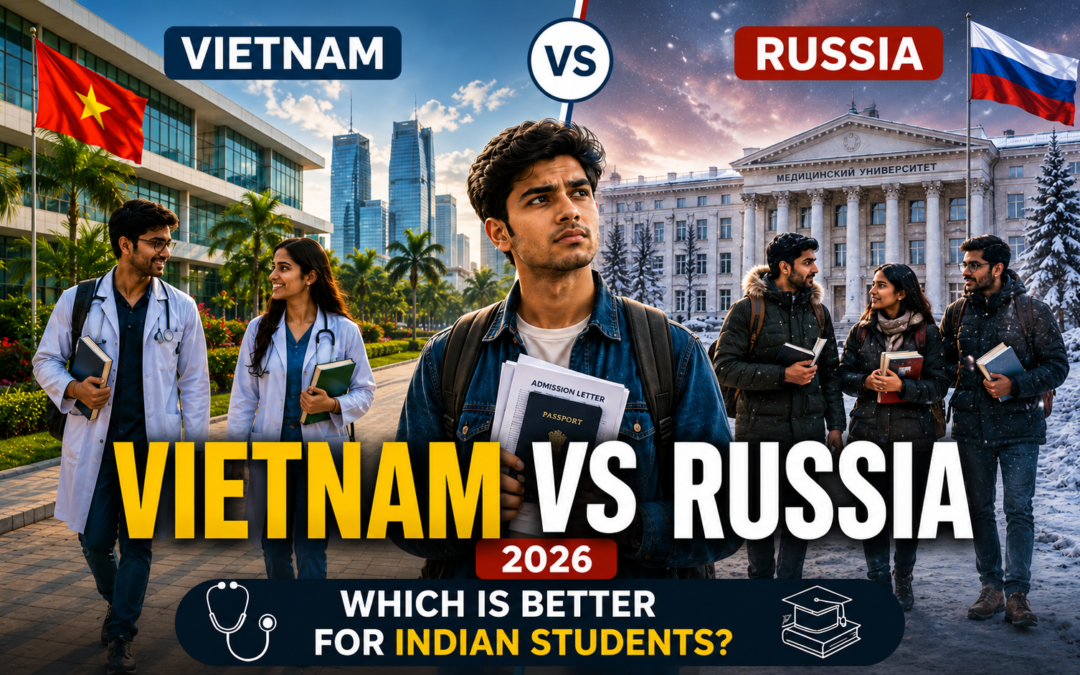
A few years ago, most students looking for MBBS abroad had one main goal — finding a country with lower tuition fees. That approach has changed a lot now. Parents are asking more practical questions today. They want to know whether their child will feel safe, whether the university gives proper clinical exposure, and whether the student can return to India confidently after graduation. Because of that, the conversation around MBBS in Vietnam vs Russia has become much more common in 2026.
Russia has been a familiar choice for Indian students for many years. Vietnam, meanwhile, is slowly becoming a country that students are starting to seriously consider. Not because of flashy advertisements, but because many families feel it offers a more balanced experience overall.
Still, both countries have their own strengths. The better option usually depends on the student’s comfort level, budget, career plans, and ability to adapt.
Why More Students Are Comparing Vietnam and Russia Now
The pressure around medical admissions in India is already high enough. On top of that, private medical college fees continue to rise every year. Naturally, more students are exploring overseas options.
But students today are researching differently compared to before.
They are not only checking tuition fees anymore.
They are comparing:
- living conditions
- safety
- weather
- food
- university quality
- NExT eligibility
- future career options
This is exactly why searches related to MBBS in Vietnam vs Russia have increased recently.
Families are trying to avoid making rushed decisions based only on social media promotions or consultancy promises.
Cost Is Important — But Students Should Look Beyond First-Year Fees
When students compare countries for MBBS abroad, the first thing they usually notice is the fee structure.
Both Vietnam and Russia are still considered more affordable than many private medical colleges in India. But one thing students often realize later is that tuition fees alone never tell the complete story.
Daily living expenses make a big difference over five or six years.
For example, many Indian students in Vietnam feel that day-to-day life is easier to manage financially. Food options, transportation, and local lifestyle costs are generally manageable for students coming from India.
Travel is also simpler. Flights are shorter, and students can travel back home more comfortably during holidays if needed.
Russia also has affordable universities, but overall expenses can vary depending on the city and climate. Students studying in colder regions may end up spending extra on winter clothing, heating-related needs, and other adjustments that are easy to overlook initially.
This is why parents should calculate the complete experience cost instead of focusing only on the admission-year fee.
Weather and Lifestyle Adjustment Matter More Than People Think
Many students underestimate how much the environment affects them emotionally.
Medical education itself is already demanding. When a student is also trying to adapt to completely unfamiliar weather and lifestyle conditions, the adjustment period can become stressful.
This is one reason some students now lean toward Vietnam.
The climate feels more familiar to many Indian students. Food adaptation is usually easier, too. Even culturally, students often feel less disconnected because of certain similarities in daily lifestyle patterns.
Russia is very different in this aspect. Students who have never experienced long winters may initially find the adjustment difficult.
Of course, thousands of Indian students continue studying there successfully. But comfort levels vary from person to person. Some students adapt quickly, while others take longer.
Parents rarely think deeply about this before admission, but students living abroad understand its importance after the first few months.
Clinical Exposure Should Be Taken Seriously
One mistake students make while selecting universities abroad is focusing too much on rankings and marketing terms.
In medicine, practical exposure matters more than impressive advertisements.
A university may look attractive online, but students should still ask:
- How much hospital exposure is available?
- Do students interact with patients regularly?
- Is the internship structure practical?
- Are students getting enough clinical learning opportunities?
These questions are important whether someone chooses Vietnam or Russia.
Vietnam’s medical education sector is still growing internationally, but many students appreciate the practical environment and the developing healthcare infrastructure.
Russia, on the other hand, has several long-established medical universities with larger international student communities. However, the quality of training still depends heavily on the individual university.
That is why students should avoid choosing a country blindly. Choosing the right university in that country matters even more.
Safety Has Become a Bigger Concern for Parents
This is probably one of the biggest shifts happening right now.
Earlier, most parents mainly worried about admission and affordability. Today, safety and emotional comfort are equally important.
Families naturally feel anxious when sending their child abroad for several years.
Many parents now prefer countries where:
- Travel feels easier
- communication feels smoother
- The environment appears calmer
- Students can adapt without feeling isolated
Vietnam is increasingly being seen as one such option.
Russia still continues to host a large Indian student population, but recent global situations have made some families more cautious while exploring choices.
That does not automatically make one country “good” and the other “bad.” It simply means parents are evaluating overall stability much more carefully now.
What About NExT and Returning to India?
This is another major area students should never ignore.
Before taking admission abroad, students must check whether the university follows proper academic and regulatory requirements.
Many students searching for MBBS abroad for Indian students focus heavily on low fees but forget to think about long-term career planning.
Students planning to practise in India later should carefully verify:
- NMC Guidelines
- course structure
- internship eligibility
- medium of instruction
- licensing requirements
The country alone does not guarantee future eligibility. The university structure matters just as much.
This is why students should avoid making decisions purely based on advertisements or “cheap package” offers.
Which Country Feels More Comfortable Overall?
There is no universal answer here.
Some students genuinely enjoy adapting to completely different environments. Others perform much better when the surroundings feel more familiar.
Many Indian students currently prefer Vietnam because:
- The climate feels easier
- Travel is shorter
- Food adjustment is simpler
- The environment feels more culturally comfortable
Russia may suit students who are comfortable adapting to colder climates and larger international environments.
In the end, students should ask themselves one simple question:
“Where can I realistically stay focused, mentally comfortable, and academically stable for the next five to six years?”
That usually leads to a more honest decision than simply chasing rankings or advertisements.
Final Thoughts
The discussion around MBBS in Vietnam vs Russia is not really about finding a perfect country. It is about finding the right environment for a student’s personal comfort, education, and plans.
Both countries continue to offer opportunities for Indian medical aspirants. But students should take time to evaluate practical realities before making a decision.
Looking beyond brochures and social media promotions is important.
Things like:
- adaptability
- student lifestyle
- clinical exposure
- safety
- career planning
- emotional comfort
often matter much more in the long run than students initially expect.
For many families in 2026, Vietnam is becoming an option worth considering because it feels balanced in terms of affordability, comfort, and growing educational opportunities.
At the same time, the final choice should always depend on the student’s individual goals and ability to adapt confidently to a new environment.